
How to store clothes and switch your wardrobe between seasons
A guide to folding, hanging, packing away and bringing back your clothes when the seasons change.

Published

Clothes rest well when they are clean, dry, in the dark, cool and with room for air. Start from that base. Then add one layer at a time: care between wears, fold or hang, packing, the resting spot, and the way back.
The method holds in every climate. Seasons are opposite in the two hemispheres, and near the Equator the year turns between wet and dry; only the moment changes. Where the weather barely changes, skip the switch and keep the rest.
The aim is plain: each piece comes out of a drawer, a rail or a box in the state it went in.
Start with the base: what a resting garment needs
Every step below rests on six conditions.
- Clean. Residues from wear change colour over time and can stain (Hagley). Food marks and oils from wear draw clothes moths (Woolmark; Kentucky Entomology).
- Completely dry. Never put a garment away damp (Kentucky Extension).
- Dark. Light damage adds up: many dyes fade, and nylon yellows and weakens (Museums Galleries Scotland; Hagley).
- Cool and steady. Museum guidance gives 10 °C to 20 °C (50 °F to 68 °F) for textiles (Museums Galleries Scotland, 2026); home guidance, no higher than 24 °C (75 °F) (Kentucky Extension, 2002).
- Not too humid. Relative humidity is the moisture in the air as a share of the most it can hold. Keep it steady between 45% and 65%; above 65%, mould gains ground (Museums Galleries Scotland, 2026).
- Room for air. Do not crowd a box or a rail.
These are targets from museum and extension guidance, not a rule for a home. Look for the coolest, steadiest, driest spot you have.
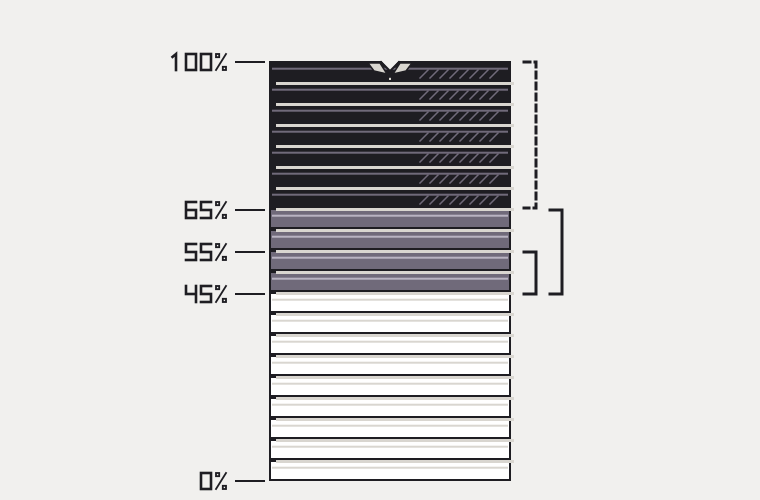
| Source | Temperature | Relative humidity |
|---|---|---|
| Museums Galleries Scotland, 2026 | 10 °C to 20 °C (50 °F to 68 °F) | 45% to 65%, stable |
| The same, against mould | Below 18 °C (64 °F) | Below 65% |
| Kentucky Extension, 2002 | Not above 24 °C (75 °F) | Under 55% |
| Museum of Brisbane, no date shown | 21 °C to 24 °C (70 °F to 75 °F) | 45% to 55% |
The humidity band is the same in a cool, damp country and in a warm, humid city. Where the air is humid, put the effort into dryness and moving air. Where it is dry, put it into dust, light and fabric pests.
Between wears: the layer you add every day
The first layer is what you do each time you take a piece off.
- Empty the pockets and take off belts and pins.
- Brush woven outer pieces, such as coats and jackets, lengthwise.
- Air the piece at least overnight on a hanger, in the shade: sunlight fades dyes. Trapped moisture leaves and creases relax.
- Fold it or hang it, with the top button or the zip closed.
- Let it rest a day before you wear it again; for wool, The Woolmark Company gives 24 hours.
Leave a gap between hangers so air reaches every piece. Now and then, open the doors of the wardrobe (the closet) and the drawers for a few hours (Kentucky Extension).
Fold or hang: sort by fabric and build
Start from one rule. Gravity stretches what hangs; pressure creases what is folded. Hang what holds its own shape. Fold what would stretch.
- Fold knitted, heavy, stretchy and bias-cut pieces, and anything heavily beaded or embellished. On a hanger they stretch and fray at the hanging points (Hagley; AIC).
- Hang woven shirts, tailored jackets, coats, sturdy dresses, skirts and trousers (Kentucky Extension).
Choose the hanger by the garment’s style and its own heaviness. A shaped or padded hanger carries the shoulder of a jacket, a coat or a delicate top across its width; a simple tubular one is enough for a light, firmly woven shirt.
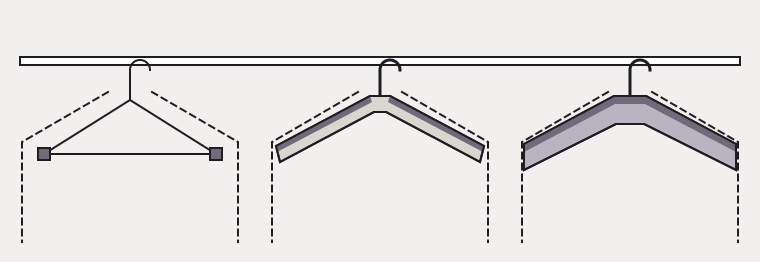
Take a top off its hanger from the bottom, so the neckline does not stretch. For a long stay, cover hung pieces with a cloth garment bag, never plastic (Kentucky Extension; Hagley). The table gives the rest, piece by piece.
| Garment | Fold or hang | How | Otherwise | Source |
|---|---|---|---|---|
| Sweaters and cardigans | Fold | Fasten; fold on the seams; tissue in each fold | Stretches and frays where it hangs | Kentucky Extension; Hagley; Woolmark |
| Jersey tops and T-shirts | Fold | Few folds; few on top | The shoulders stretch | Kentucky Extension |
| Woven shirts and blouses | Hang | Shaped hanger; top button closed | Creases set in a fold kept for months | Kentucky Extension |
| Tailored jackets, coats and suits | Hang | Shaped or padded hanger; brush first; cloth cover | The shoulders lose their line | Kentucky Extension; Woolmark |
| Woven trousers | Hang, or fold once | From the cuff or hem, over a padded bar, or folded at the knee | A sharp crease across the leg | Kentucky Extension |
| Skirts and sturdy dresses | Hang | From the waist loops; cotton under a clip | Clip marks; strained shoulders | Kentucky Extension; Hagley |
| Bias-cut, beaded or embellished pieces | Fold flat | Padded folds; nothing on top | Hanging pulls them out of shape | Kentucky Extension; AIC |
| Woven silk | Hang if sturdy; otherwise fold | Padded hanger or tissue; a closed container for a long stay | Clothes moths feed on animal fibres | Kentucky Extension; Kentucky Entomology |
| Rayon and viscose | Hang if sturdy, or roll around tissue | Keep it bone dry | Creases; takes up damp; mildew | Hagley |
| Polyester, nylon and acrylic | Either | Clean first; keep nylon dark | Holds oils from wear; nylon yellows | Hagley |
| Denim and sturdy cotton | Either | Folded on the seams, or hung | Little; suits a lidded bin | Woolmark; Kentucky Extension |
Two folds worth learning
The base of every fold is a clean, flat surface. Each rule adds one layer:
- Fold as few times as you can, on seam lines or natural wearing lines such as the waist or the knee (Kentucky Extension).
- Soften each fold with white tissue or a loose roll of clean cotton, so it bends instead of creasing (Hagley; AIC).
- Avoid stacking pieces that crease where you can; when you stack, put the heaviest piece at the bottom (Kentucky Extension). Textile conservators go further and do not stack folded pieces at all (AIC, 2024).
The two folds below are Risr’s own arrangement of those rules. The sources give rules, not numbered folds: read each as a fold that follows them, not as a standard.
A knitted sweater
A sweater (a jumper, in part of the English-speaking world) stretches on a hanger, so it folds.
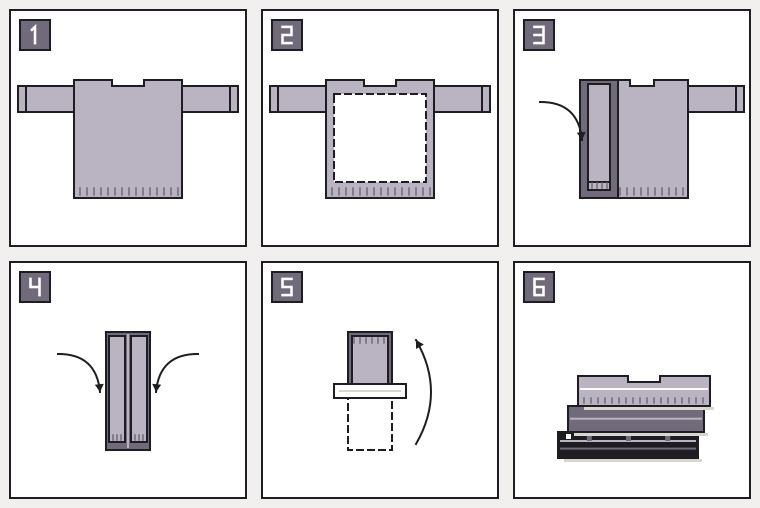
- Close any buttons or zip. Lay the sweater front side down on a clean, flat surface and smooth it.
- Lay a sheet of white tissue over the back.
- Fold one side in by about a third, from shoulder to hem. Turn the sleeve at the armhole seam and lay it straight down that panel.
- Do the same on the other side.
- Lay a loose roll of tissue across the middle. Bring the hem up to the shoulders in one fold, over the roll.
- Turn it over and set it on the stack, with heavier pieces beneath it.
Woven trousers
Trousers fold once, at a natural wearing line: the knee.
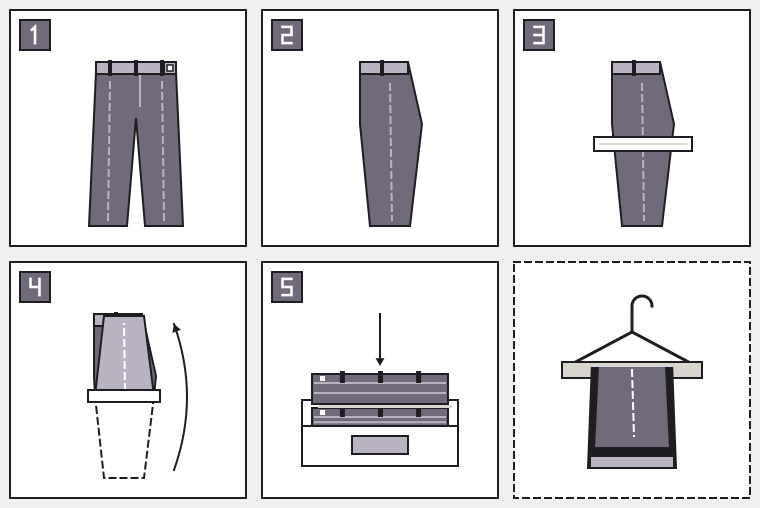
- Close the fastening and hold the trousers by the hems.
- Match the leg seams so each leg lies along its own crease line. Lay them flat.
- Lay a loose roll of tissue across the knees.
- Fold once at the knee, hems up to the waistband, over the roll.
- Lay them in the box, after the heavier pieces.
Before you pack away: clean, dry, check, wrap
The base of storage is a clean garment. Clean every piece first by its care label: the five symbols, for washing, bleaching, drying, ironing and professional textile care, show the most the fabric takes, and gentler treatment is always allowed (GINETEX).
Then add, one at a time:
- No finishing products. Skip starch, sizing and fabric softener on what you will store. Mildew and some insects feed on them (Kentucky Extension).
- Fully dry. Not nearly dry: completely.
- Small repairs first. See to a loose button or an open seam before the piece goes away.
- A soft wrap. A clean cotton sheet or pillowcase, or white tissue (Kentucky Extension). Tissue also helps against yellowing and snags (Woolmark).
Then choose the container for what it does.
| Container | What it does | Limits | Source |
|---|---|---|---|
| Cotton bag | Lets air through; keeps dust off | Not closed against insects | Woolmark; Kentucky Extension |
| Lidded card box | Lets some air in; takes up a little moisture | Insects can get in; line it with cotton or tissue | Hagley; Kentucky Extension |
| Lidded plastic bin | Closed against insects; suits sturdier pieces | Good only while moisture-tight; clear plastic lets light in | Woolmark; Kentucky Entomology; Hagley |
| Vacuum bag | Takes less room; shows what is inside | May need resealing; no air; poor for delicate pieces | Woolmark |
| Suitcase or trunk | A closed container you may already have | Lay the clothes in a pillowcase so they lift out together | Kentucky Extension |
The sources disagree on sealing. Extension guidance says avoid plastic bags, because they trap moisture (Kentucky Extension). Entomologists and the wool organisation say close animal fibres in tightly (Kentucky Entomology; Woolmark). Risr’s reading: seal clean, bone-dry wool, silk and other animal fibres where moths are a concern, and let air reach everything else.
Do not overfill: a packed box presses soft folds into creases (Kentucky Extension; Hagley).
Where the stack rests: cool, dry, dark, steady
Choose the spot by its conditions, not by its room.
- Away from heat sources and direct sun.
- Away from spots that swing between hot and cold or run damp: an outside wall, under the roof, below ground level, beside a radiator (Museums Galleries Scotland).
- Off the floor, on a shelf you have cleaned first. Clean it again at least once a year (Kentucky Extension, 2002).
- On unfinished wood, line the shelf or drawer first: contact with bare wood or paper can yellow fabric (Kentucky Extension).
Damp and mildew on fabric
Mildew weakens natural fibres, discolours synthetic ones and can leave holes; in warm, humid conditions it forms quickly (Kentucky Extension). Rayon is sensitive to it (Hagley). The signs are a musty smell and greyish spots.
Prevention is dryness and moving air: nothing damp, no crowding, no plastic covers, doors and drawers open on dry days. Sachets of silica gel take up moisture; change them or dry them out from time to time (Kentucky Extension; Woolmark).
Keep fabric pests out: clothes moths and carpet beetles
Start with what does the damage: not the adult clothes moths and carpet beetles, but their larvae. They feed on animal fibres: wool, silk, fur, feathers, felt and leather. Cotton and synthetics are rarely attacked, unless blended with wool or marked with food or oils from wear. They prefer dark, undisturbed places, so stored woollens are at risk and clothes in regular use seldom are (Kentucky Entomology).
Prevention comes in four layers:
- Clean every piece before it goes away.
- Close animal fibres in a tight-fitting bag or container.
- Keep the storage space clean, and vacuum along edges and corners.
- Look inside now and then, at seams, folds, cuffs and collars, and at least once a year (Kentucky Entomology, 2026; Museum of Brisbane, no date shown).
The signs are irregular holes, thin patches where the surface looks grazed, silky webbing or small cases, and the empty casings that larvae shed as they grow (Kentucky Entomology).
Cedar blocks and lavender sachets divide the sources: The Woolmark Company suggests cedar, and the University of Kentucky’s entomologists find cedar chests seldom effective. Treat them as a scent, not as protection. Keep them off the fabric; their oils can leave marks (Kentucky Extension).
The switch, both ways
The trigger is the weather, not the date. When it turns, move clothes in stages; pieces for in-between weather stay out longest. Where the year turns between wet and dry, the switch follows that turn.
Putting away
- Sort what is leaving for the next few months.
- Clean each piece by its care label and let it dry fully.
- Check for small repairs and see to them.
- Decide, piece by piece, whether it folds or hangs.
- Wrap and pack, heaviest at the bottom, without overfilling.
- Label each container with its contents and the date.
- Place it in the coolest, driest, darkest spot you have.
- Clean the freed rail and shelves before the incoming clothes go in.
Midway through the season, open each container once: look for damp and pests, and refold.
Bringing back
- Unpack on a clean surface and look over each piece.
- Air it before it goes into the wardrobe.
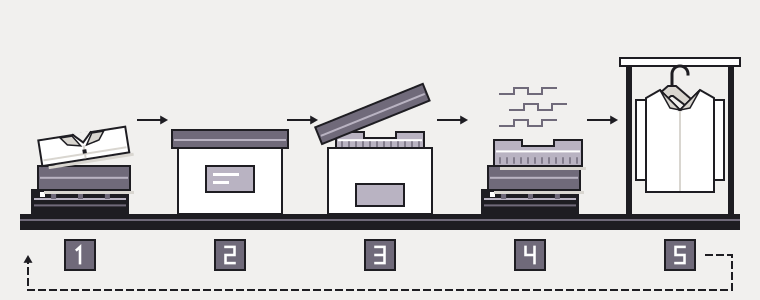
- Relax the creases. Hang wool, wool blends and other hair-fibre pieces in a steamy room, then let them hang overnight or for several hours; press what remains as the iron symbol on the label allows. Press other fabrics by their label (Kentucky Extension).
- Hang or fold each piece again by the table above.
- Empty, clean and air the containers before you refill them.
| Interval | What | Source |
|---|---|---|
| At least overnight | Air a worn piece before it goes back | Kentucky Extension, 2002 |
| One day; 24 hours for wool | Rest between wearings | Kentucky Extension, 2002; Woolmark, no date shown |
| At least once a year | Look at stored clothes; clean the storage space | Kentucky Extension, 2002; Museum of Brisbane, no date shown |
| At each look, or every two years | Refold along new lines | AIC, 2024 |
| At least one week at −18 °C (0 °F) | Cold method for a piece with signs of pests | Kentucky Entomology, March 2026 |
Short answers
Can clothes stay in the plastic cover from professional cleaning?
No. Take it off as soon as the clothes are home: it traps moisture and can yellow fabric (Kentucky Extension; Hagley). Use a cloth garment bag.
Why did a white garment yellow in storage?
Usually a plastic bag, contact with wood or paper, or residues left in the fabric (Kentucky Extension). Clean first and put white tissue in the folds.
I found a small hole when I unpacked. What now?
Look for webbing, small cases or empty casings. If you find any, use the cold method above, then clean the piece, vacuum its space and look over its neighbours.
What if there is no cold season where I live?
The switch may run between the wet and the dry season, or not at all. Everything else still applies.
Sources
The short name used in the text comes first. Read how Risr checks its sources.
- Kentucky Extension. University of Kentucky Cooperative Extension, Linda Heaton, Clothing Storage (CT-LMH.144). Revised January 2002.
- Hagley. Hagley Museum and Library, Ebenezer Kotei, Preserving Your Memories: How to Preserve Your Synthetic Clothing. 2011.
- Museums Galleries Scotland. Caring for textile collections. Last updated 10 June 2026.
- AIC. American Institute for Conservation, Textile Specialty Group, Storage of Textiles, Section D: Storage Methods, Conservation Wiki. Last edited 22 February 2024.
- Woolmark. The Woolmark Company, Caring for wool and How to store wool clothes. No date shown; seen 16 November 2026.
- Kentucky Entomology. University of Kentucky Entomology, Michael F. Potter, Clothes Moths (ENTFACT-609) and Carpet Beetles (ENTFACT-601). Both revised March 2026.
- Museum of Brisbane. Louise McCullagh, How to conserve your textiles. No date shown; seen 16 November 2026.
- GINETEX. Care labelling and Care symbols. No date shown on the pages; the symbols are the basis of ISO 3758:2023, published 6 December 2023; seen 16 November 2026.